For coaches, grip strength can easily become an afterthought; something that develops indirectly from deadlifts, carries, pull-ups or kettlebell work. However, we need to think about grip much more broadly. Because it is not simply how hard someone can squeeze; grip represents the interface between the person and the environment. It influences how we hold, pull, push, carry, stabilise and, ultimately, transfer force through the rest of the body.
The origin of the inspiration
A large part of my own thinking around this came from my good friend and mentor John Brookfield. John is a former strongman, the creator of the Battling Rope system and someone who has spent decades exploring unconventional approaches to strength and physical performance. I have had the opportunity to travel and train with John on two separate occasions, learning not only his Battling Rope methodology but also many of the strongman and unconventional training techniques that have shaped his approach.
- Former strongman
- Creator of the Battling Rope system
- Decades exploring unconventional approaches to strength
What always struck me about training with John was that strength wasn’t confined to conventional gym equipment. We worked with ropes and other unconventional objects, manipulated different surfaces and challenged the hands and body in ways that were very different from simply adding another plate to a barbell. Grip and grasp were central to much of it.
Different objects forced you to squeeze, clamp, crush, hold, pull and continually adjust. The hands were not simply attaching you to the exercise; they became an active part of solving the movement problem. That experience stayed with me.
Over the years, as I continued to develop our approach to functional training at the Functional Training Institute, I became increasingly interested in how we could take some of these principles and make them practical for everyday coaches. You don’t need to be a strongman, nor do you need a warehouse full of specialist equipment. A towel, resistance band, kettlebell, medicine ball or battling rope can completely change the grip demand if we understand how to manipulate it.
Each one can completely change the grip demand.
That thinking has ultimately led John and me to collaborate on the development of a Grip and Grasp course, bringing together his strongman and unconventional training methodology with my own interpretation of how these principles can be applied within functional training and contemporary coaching environments.
This article is a taste of that collaboration. Rather than simply showing you another collection of grip exercises, I want you to think differently about the interaction between the hand, implement, body and environment. We can manipulate the implement, hand position, tension, thickness, direction of force and movement itself, to develop grip strength and endurance in ways that are adaptable, progressive and relevant to human performance. That idea also reflects the original intention of this series: moving beyond fixed apparatus and one-dimensional gripping into different tools, positions and movement demands.
Grip strength and endurance that is adaptable, progressive and relevant to human performance
Grip strength is about more than performance
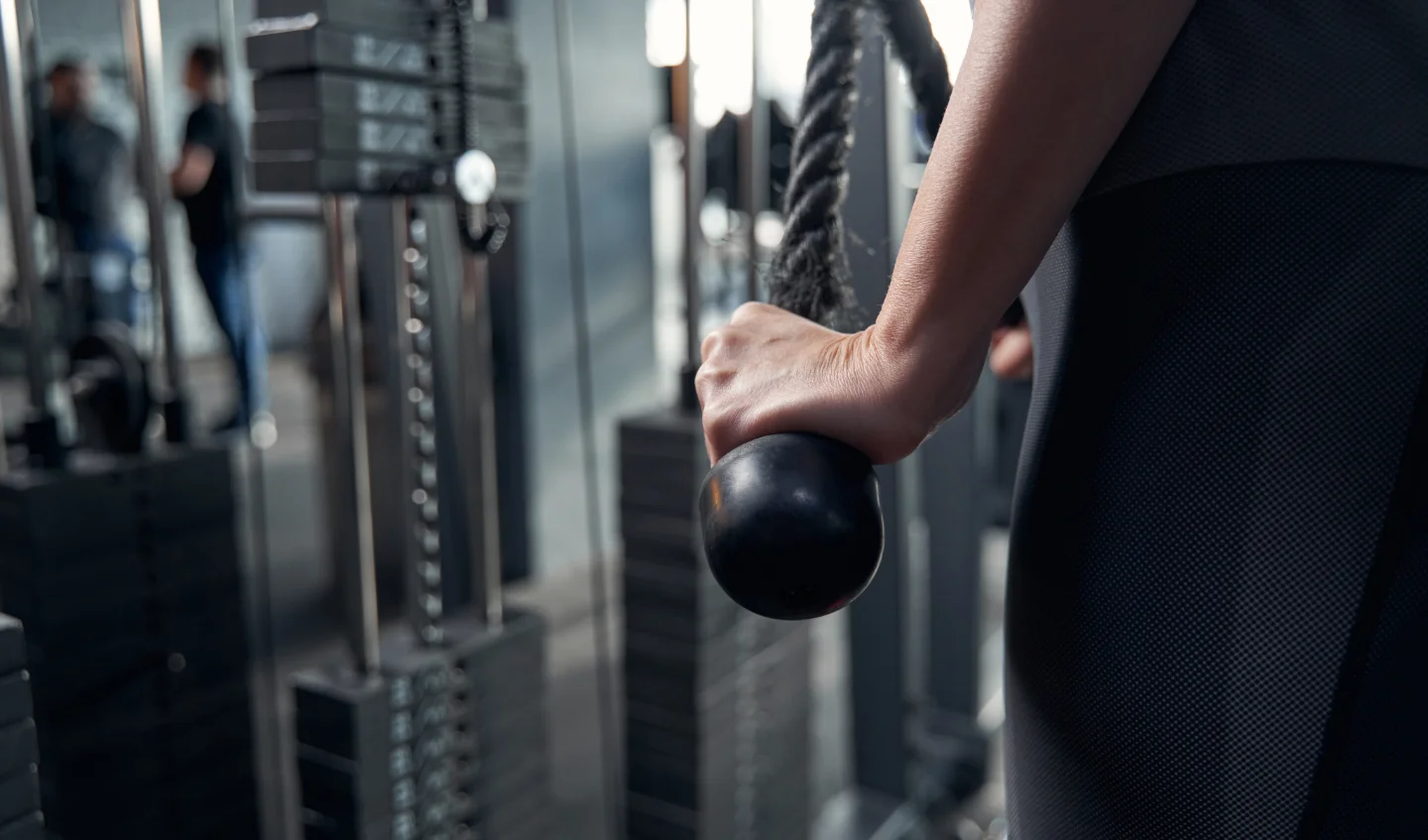
There is another reason coaches should pay attention to grip: it tells us something about the person beyond their ability to hold a heavy object.
Handgrip strength, commonly measured using a handgrip dynamometer, has been extensively studied as a simple marker of overall muscle strength and physical function. In the large Prospective Urban Rural Epidemiology (PURE) study involving nearly 140,000 adults with known vital status, each 5 kg reduction in grip strength was associated with a 16% higher risk of all-cause mortality during follow-up. Importantly, this is an association, not evidence that weak grip itself causes earlier death. Rather, grip strength appears to provide a useful window into broader physical capacity and health.
Nearly 140,000 adults with known vital status
Each 5 kg reduction in grip strength
Higher risk of all-cause mortality during follow-up
This is an association, not evidence that weak grip itself causes earlier death.
That relationship has subsequently been observed across a much larger body of research. A systematic review and dose-response meta-analysis involving more than three million participants, found strong evidence linking lower handgrip strength with greater all-cause mortality risk.
More than three million participants. Strong evidence linking lower handgrip strength with greater all-cause mortality risk.
Grip strength is also relevant to how well we function as we age. Research has associated lower handgrip strength with mobility limitations and reduced independence in activities of daily living, while contemporary sarcopenia guidelines use grip strength as one method of identifying low muscle strength.
For me, this is where the conversation around longevity becomes meaningful for fitness professionals. Longevity should not simply mean adding years to life. We want our clients to retain the physical capacity to do things with those years, to lift, carry, move, play, train and interact confidently with their environment.
In the following video, you’ll explore the relationship between grip strength, physical capacity, performance and longevity, as well as why grip strength has become such a useful measure in research and clinical settings.
Not all grips are created equal
Once we appreciate why grip matters, we can start looking at how we grip.
Most fitness professionals are familiar with the traditional language of pronated, supinated and neutral grips. A pronated position generally places the palms down or away; a supinated position reverses that orientation; while a neutral grip places the hands more into a handshake-type position, with the thumbs generally pointing upward. These positions matter because they change the orientation of the hand and forearm relative to the implement. We see them everywhere, from chest presses and rows to chin-ups, dumbbells, machines and kettlebells. But this only tells part of the story.
Palms down or away
Reverses that orientation
A handshake-type position, with the thumbs generally pointing upward
The next question I want you to ask is: ‘What is the hand actually doing once it gets there?’ This brings us to the difference between open-hand and closed-hand gripping.
With a closed grip, the hand wraps around the implement and we can actively crush the handle. That deliberate squeeze can contribute to greater muscular tension and help create stability beyond the hand itself. Think about performing a heavy press. When we deliberately crush the handle, we are not simply preventing the weight from falling out of the hand. We are creating tension that can contribute to the organisation and stability of the arm, shoulder and wider kinetic chain. In other words, sometimes we want tension. But sometimes we don’t.
In the next video, you’ll see the different grip orientations and learn why the position of the wrist and forearm should not be confused with what the hand itself is doing. This distinction gives you a much clearer framework for choosing and cueing grip, according to the task.
Knowing when to grip and when to relax
This distinction becomes particularly important when we move into more dynamic training.
Take the kettlebell swing. Rather than crushing the handle throughout every repetition, I often teach a more open-hand position, or what I call a ‘cleaver’ position. The bell sits more through the fingers, while the thumb provides enough security to maintain control. This is different from a traditional ‘hook grip’, where the thumb wraps around the bar and the fingers close over it to create a highly secure grip, which is commonly seen in Olympic weightlifting.
The bell sits more through the fingers, while the thumb provides enough security to maintain control.
The thumb wraps around the bar and the fingers close over it to create a highly secure grip.
Why does this matter? Because constantly applying maximum tension has a cost.
If I unnecessarily crush a kettlebell handle through a long set of swings, I am asking the forearm musculature to work harder than the task necessarily requires. That may accelerate local fatigue and interfere with the rhythm and fluidity we want during ballistic kettlebell movements. An appropriately open and relaxed grip allows us to maintain control without creating tension simply for tension’s sake. However, and this is an important coaching distinction, open does not always mean relaxed.
For example: put a medicine ball between your hands and actively clamp into it with the fingertips. There may be no handle to wrap around, so technically we are using an open-hand strategy, yet the grip can be extremely active. Add a squat while maintaining that clamp and suddenly the hands are contributing to a much larger whole-body task through neural drive. This same concept can be applied to a power bag: clamp, squeeze and stabilise the bag by creating enough tension to activate the posterior and anterior chains of the upper body.
Now, return to the kettlebell and we can start moving between strategies. During a clean, I can allow the hand to remain relatively open and the wrist relaxed as the bell transitions into the rack. If I then want greater tension for a heavy squat or press, I can close the hand, crush the handle and increase whole-body tension. Once that task is finished, I can release unnecessary tension and transition again.
Hand relatively open, wrist relaxed as the bell transitions into the rack
Close the hand, crush the handle and increase whole-body tension
Release unnecessary tension and transition again
This is what makes grip training a skill rather than simply an exercise for the forearms. The coach is teaching the athlete or client when to create tension, when to reduce it and how the hand interacts with different implements and movement demands.
The third video puts this into practice. Using a medicine ball, power bag and kettlebell, you’ll see how open and closed grips can both be used actively, and how we can transition between relaxation and tension according to what the movement requires.
Moving beyond the handle: grip and grasp
This final part of this article brings the series back to where much of the inspiration began: John Brookfield’s unconventional approach to strength.
One of the lessons I took from training with John was to stop assuming that strength, and particularly grip strength, has to be developed through a perfectly shaped, fixed handle. In the real world, objects rarely present themselves to us like a dumbbell.
Something as simple as a towel and resistance band completely changes the interaction. Because, unlike a fixed bar, dumbbell or machine handle, a towel moves. It folds, compresses and changes shape. Suddenly the fingers and thumbs have to clamp, grasp and continually organise themselves against a less predictable surface.
Attach that towel to a resistance band and we introduce another variable: changing force.
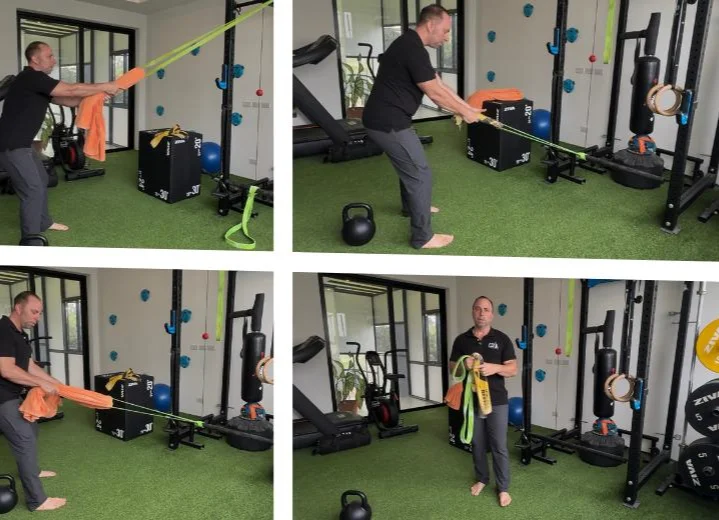
As you move farther from the anchor point, the band stores more elastic energy and increases the demand on the grip. You now have to maintain your grasp while controlling the pull of the band back toward the anchor, particularly during the eccentric return. From there, the options multiply.
Change from a thinner towel to a thicker one. Increase the resistance of the band. Alter the anchor height. Change the direction of the pull. Move from a neutral grip into different arm positions. Add an overhead reach or challenge the client or athlete to control the deceleration while maintaining their grasp.
Change from a thinner towel to a thicker one
Increase the resistance of the band
Alter the anchor height
Change the direction of the pull
Move from a neutral grip into different arm positions
Add an overhead reach or control the deceleration
What started as a grip exercise has now become a much richer interaction between the hand (including fingers and thumb), arm, trunk and environment. These towel-and-band variations are directly inspired by what I learned from John, adapted through my own coaching lens and the FTI approach to functional performance.
That is functional training in its truest sense. It is not about making an exercise unusual simply for the sake of novelty, but manipulating the task so the client or athlete has to adapt and organise movement in response to a meaningful challenge inside and outside the gym.
In the final video, I bring this unconventional approach to life using nothing more complicated than a towel and resistance band. Watch how changes in towel thickness, band tension, body position and direction of force can transform a simple grip exercise into a much more integrated grip-and-grasp challenge.
Grip with purpose
The takeaway from this series is not that every client needs a dedicated 30-minute grip workout. It is much simpler than that.
Simply: start paying attention to the hands. Ask yourself:
‘What grip is contributing to the movement?’
‘Does the client need more tension or less?’
‘Would an open or closed strategy better serve the task?’
‘Can changing the thickness, orientation or stability of the implement create a useful new challenge?’
‘Can the athlete maintain their grip while the rest of the body moves, stabilises or absorbs changing forces?’
Most importantly, give the grip purpose. For an athlete, that may mean maintaining control of an implement under fatigue. For a kettlebell practitioner, it may mean learning to transition efficiently between relaxation and tension. For an older client, it may mean preserving the strength and physical capacity required to carry, lift, grasp and confidently interact with their environment.
Maintaining control of an implement under fatigue
Learning to transition efficiently between relaxation and tension
Preserving the strength and physical capacity to carry, lift, grasp and interact with their environment
Performance, health and longevity do not exist in separate boxes. Good coaching should help people develop physical qualities that remain useful beyond the gym.
Perhaps that is one of the biggest lessons I have taken from John over the years: strength does not always have to be conventional to be functional. Changing the object, the grip, the direction of force or the environment can create an entirely different training stimulus. Our responsibility as coaches is to understand why we are creating that stimulus and how it serves our client or athlete.
Grip training, therefore, should not simply be about producing a stronger squeeze. It should help people develop the strength, endurance, adaptability and control to interact more effectively with loads, implements and their environment, whether the goal is improved sporting performance, greater training capacity or maintaining physical independence as they age.