What is Zone 2?
The first challenge is that there is no single universal definition of Zone 2. Different training systems use 3, 5 or even 7 zones, and researchers can identify Zone 2 using heart rate, blood lactate, ventilation, power output or fat oxidation.
In everyday coaching terms, Zone 2 is best thought of as a steady, sustainable aerobic intensity where breathing has increased but remains controlled. The client should still be able to speak in sentences, although it should be obvious that they are exercising.
A 2025 study by Meixner and colleagues tested 50 experienced cyclists and compared several commonly used ways of identifying Zone 2. They found substantial differences between methods. Fixed percentages of maximum heart rate and fixed blood-lactate values did not consistently represent the same metabolic intensity from one person to another. In contrast, more individualised measures such as the first ventilatory threshold, or VT1, and maximal fat oxidation showed better agreement.
- Fixed percentages of maximum heart rate
- Fixed blood-lactate values
- First ventilatory threshold (VT1)
- Maximal fat oxidation
For most fitness trainers, metabolic carts and blood-lactate testing are obviously not practical. Fortunately, simple tools such as the talk test, breathing response and perceived effort can provide useful real-world guidance. Research on the talk test shows that the point where comfortable speech begins to become more difficult corresponds reasonably well with the first ventilatory threshold.
Heart rate can still be useful, but it should be treated as a reference point rather than the definition of Zone 2.
Why bother with Zone 2?
One reason Zone 2 has attracted so much attention is its potential effect on the mitochondria – the structures inside our muscle cells responsible for producing much of the energy required for aerobic exercise.
At these sustainable aerobic intensities, the mitochondria are heavily involved in producing energy from both fat and carbohydrate. With regular training, the body can become better at using oxygen, oxidising fat and switching between available fuels, a concept known as metabolic flexibility. This becomes particularly relevant when we consider conditions such as insulin resistance, metabolic syndrome and type 2 diabetes, where impaired metabolic and mitochondrial function can be part of a much more complex disease process.
Lactate is also part of this story. Far from being a waste product, lactate is an important fuel that can be shuttled between muscle fibres and oxidised inside mitochondria. San Millán notes that during sustained Zone 2 exercise, lactate turnover can even exceed glucose turnover, making lactate a major circulating fuel while production and clearance remain in balance.
The attraction of Zone 2 is therefore fairly simple: it allows clients to accumulate a substantial amount of aerobic work while placing a relatively manageable level of stress on the body.
But Zone 2 is not magic
This is where trainers need to be careful.
A 2025 review titled Much Ado About Zone 2 challenged some of the stronger claims surrounding Zone 2 training. The authors concluded that “current evidence does not support Zone 2 training as the optimal intensity” for improving mitochondrial or fat-oxidation capacity.
That does not mean Zone 2 does not work. It means we should not assume it is uniquely superior to other forms of aerobic exercise. Higher-intensity exercise can also produce substantial mitochondrial, cardiovascular and metabolic adaptations and may be particularly valuable when clients have limited time available.
There is also a risk at the other end of the spectrum. If trainers prescribe Zone 2 too conservatively, clients may simply perform very-low-intensity exercise and fail to generate the intended training stimulus. So the aim should not be to make every aerobic session Zone 2.
How long should a Zone 2 session be?
Exercise physiologist Iñigo San-Millán, one of the major proponents of Zone 2 training, has commonly recommended approximately 60-90 minutes per session when the goal is substantial metabolic and mitochondrial conditioning. This should not be interpreted as a proven “60-minute minimum”. Exercise adaptations occur across a range of training doses, and beginners may need to start with much shorter sessions.
The practical message is that duration matters. Spending five minutes in Zone 2 during another workout is unlikely to provide the same stimulus as a dedicated, sustained aerobic session. For many clients, a sensible progression may, therefore, be to gradually build towards 45–60 minutes or more of continuous Zone 2 exercise.
A simple way trainers can use this
It can be difficult to understand Zone 2 from numbers alone. Watch this short demonstration where Dr Peter Attia shows what a Zone 2 cycling session actually looks and feels like, including the breathing and perceived effort involved:
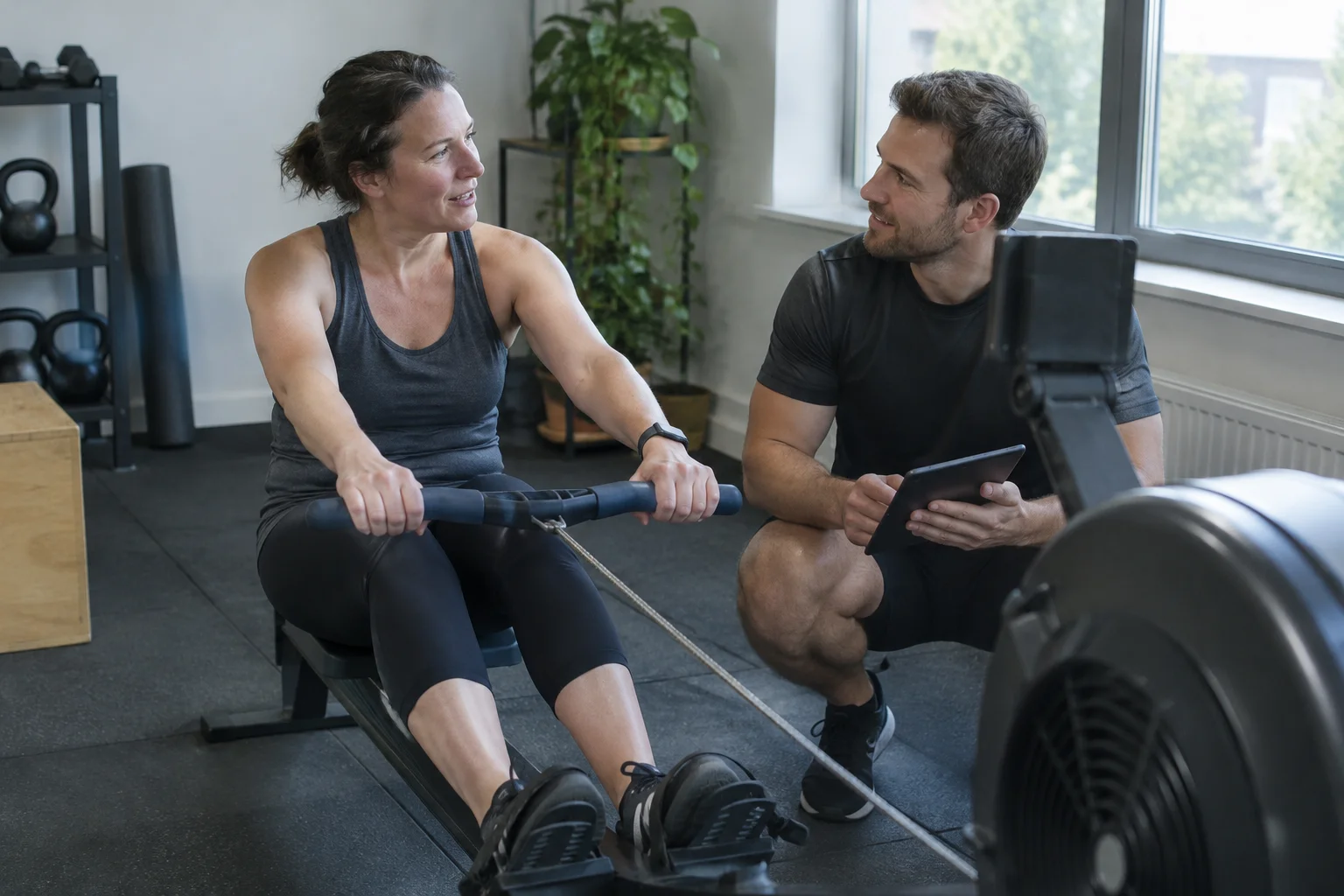
During a PT session, place the client on a bike, treadmill, rower or cross-trainer and gradually increase the workload over approximately 10–15 minutes. Find an intensity where:
- breathing is clearly elevated but controlled;
- the client can still speak in sentences;
- they are not gasping or struggling to talk; and
- the effort feels sustainable for an extended period.
Record the machine workload, pace and heart rate at that point. Heart rate now becomes a useful individual reference, rather than something calculated from an age-predicted formula.
The trainer might then prescribe:
As fitness improves, build the continuous Zone 2 component towards 45–60+ minutes, perhaps two or three times per week, depending on the client’s goals and overall training program.
Most importantly, teach the client how to monitor the session themselves. If breathing becomes difficult and conversation starts breaking down, reduce the workload. If the effort feels extremely easy, gradually increase it.
A trainer does not need to supervise an hour of Zone 2 exercise. The real value lies in teaching the client how to recognise and independently reproduce the correct intensity between supervised sessions.
Take-home message
Zone 2 can be an effective way to build aerobic and metabolic fitness, but it is not a magic intensity and should complement, not replace, other forms of exercise.
Meixner et al. (2025), Zone 2 Intensity: A Critical Comparison of Individual Variability in Different Submaximal Exercise Intensity Boundaries
Storoschuk et al. (2025), Much Ado About Zone 2
Reed & Pipe (2014), The Talk Test: A Useful Tool for Prescribing and Monitoring Exercise Intensity
San Millán, I. (2026), Zone 2 Is a Metabolic Equilibrium Point, Substack.