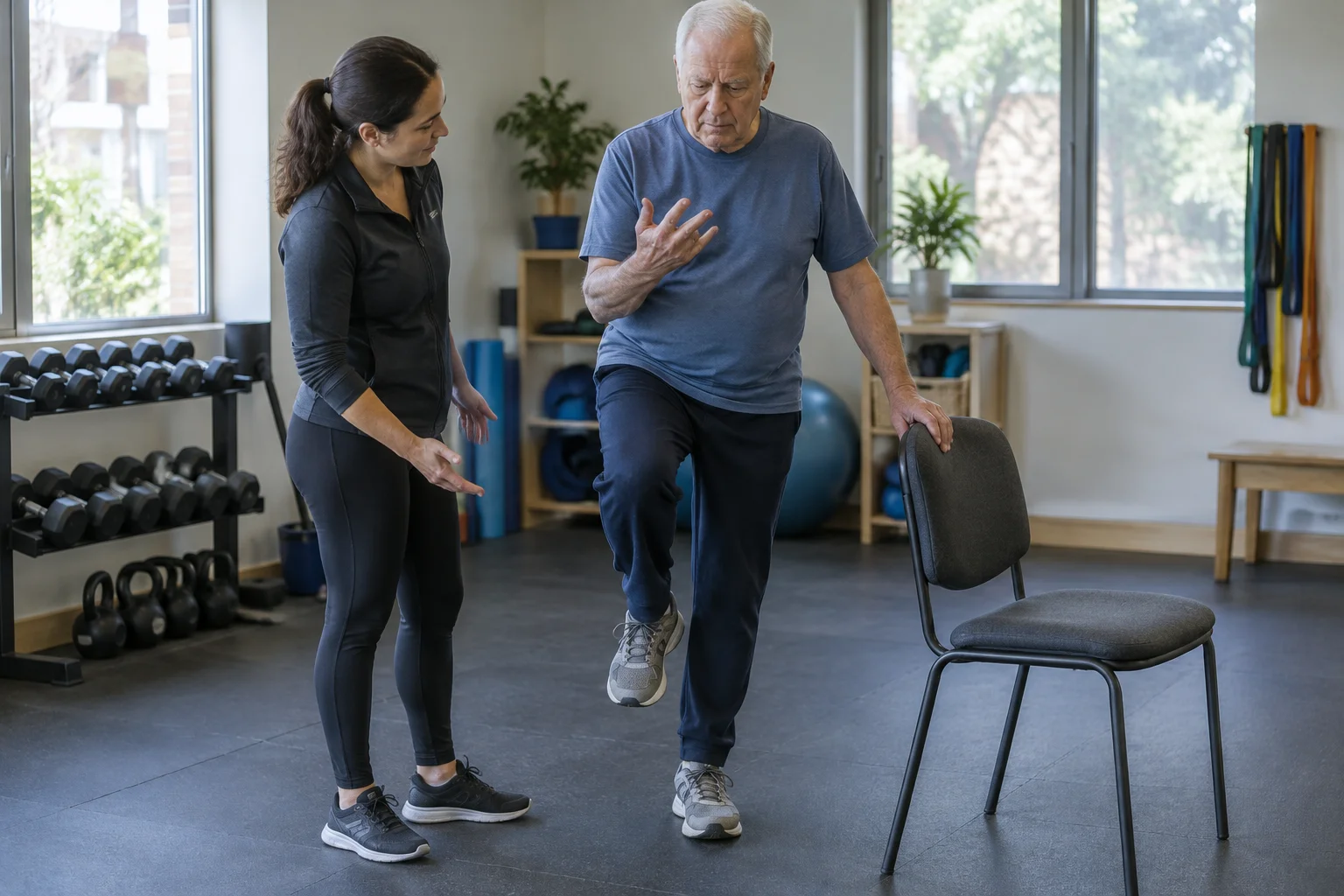
Walk into a group exercise class with older adults working on their balance and you might see a similar setup: participants standing on one leg, staring at a spot on the wall.
This type of traditional training looks structured and focused – task-specific like you’d expect it to be – but it actually ignores how our body and brain operates in the real world.
Outside of the gym, nobody loses their footing in a one-legged mountain pose. Older adults trip and fall when they miss a curb while reaching for keys, or misjudge a step when they take a phone call. In other words, when they’re doing two things at once.
If your programming relies exclusively on traditional single-task training, you are preparing participants for a static environment that doesn’t exist. Instead, to build genuine functional resilience, we must integrate dual-tasking into our sessions – turning controlled gym strength into reliable, real-world protection.
Dual-Task Cost: The price we pay for doing two things at once
When we divide our attention between two tasks, for example walking through the supermarket and remembering our shopping list, our brains have to allocate brain power to each task. And that resource is finite. Consequently, the execution of those two tasks can take a hit – we might walk a little slower, and take a little longer to recall whether it was plain flour or self-raising flour that we were low on.

For older adults, there is less brain power available to start with, due to age-related declines in brain volume and neural efficiency. Motor and cognitive tasks also require more brain power to be executed, because the ageing brain must recruit additional neural networks to perform actions that used to come naturally. For example, in the supermarket, an older participant might come to a stop halfway down the baking aisle, forget it was flour they came for, and grab the sugar instead.
So, as instructors tasked with preparing their body for the real world, we need to prepare their brain too. We need to be providing the right stimulation in class to boost cognitive capacity, drive neuroplasticity, and lower that dual-task cost (and yes, it’s possible at any age).
Dual-Task Training: Multi-tasking with purpose
Put simply, dual-task training is doing two or more tasks at once, with purpose and progressions. In class, this can mean starting with a base motor task like a shoulder press or tandem hold (or any cardio, balance, or strength exercise), then layering on a second task, either cognitive, environmental, or another motor. This forces the brain to split its cognitive load in a controlled, safe environment.
Unlike the random distractions of daily life, progressive dual-task training systematically nudges the brain just past its current capacity. That step-by-step progression is key: it keeps challenging the brain to share attention across tasks without overloading the system and triggering a complete breakdown in performance. This sharpens executive function under pressure, giving the brain the extra bandwidth it needs when real-world distractions happen. And for our participants, that could be the difference between a stumble that remains a near-miss – and one that becomes a hip fracture.
Traditional Training vs Real-World Training: What the science proves
When you compare dual-task training directly to traditional single-task strength and balance work, the clinical research reveals the divide: standard exercise conditions the muscles, but dual-task training fundamentally changes how the brain executes movement under pressure.
A 2022 meta-analysis published in the Journal of Prevention of Alzheimer’s Disease, spanning 21 clinical trials and 2,221 participants, proved that dual-task training drives these measurable, system-wide improvements across both brain and body in older adults living with cognitive impairment, dementia or Alzheimer’s disease.
Small wins: General brain function, walking speed, and memory all showed small, statistically real improvements.
Moderate wins: Executive function took a stronger step up, sharpening real-time decision-making under load. Balance saw a similar gain, directly improving physical stability.
But the biggest win? Lowering the dual-task cost. Remember, dual-task cost is that drop in performance when our attention is split between two tasks. Dual-task training produced its single largest effect here, shrinking cost by nearly double the size of any small gain.
Training for independence
As instructors, our job isn’t just keeping participants safe in class – it’s equipping them to move safely outside of it. A squat or tree pose only delivers true value if it translates directly to real-world benefits.
Participants often tell us they come to class to build strength, but they don’t want bigger muscles – they want their independence. And strength alone won’t keep someone upright when an unexpected distraction strikes.
By incorporating dual-task training in classes, we build the mental bandwidth needed to handle those real-life moments – giving participants the capacity to navigate the world on their own terms.
*Ali N, Tian H, Thabane L, Ma J, Wu H, Zhong Q, Gao Y, Sun C, Zhu Y, Wang T. The Effects of Dual-Task Training on Cognitive and Physical Functions in Older Adults with Cognitive Impairment; A Systematic Review and Meta-Analysis. J Prev Alzheimer’s Dis. 2022;9(2):359-370. doi: 10.14283/jpad.2022.16. PMID: 35543010.